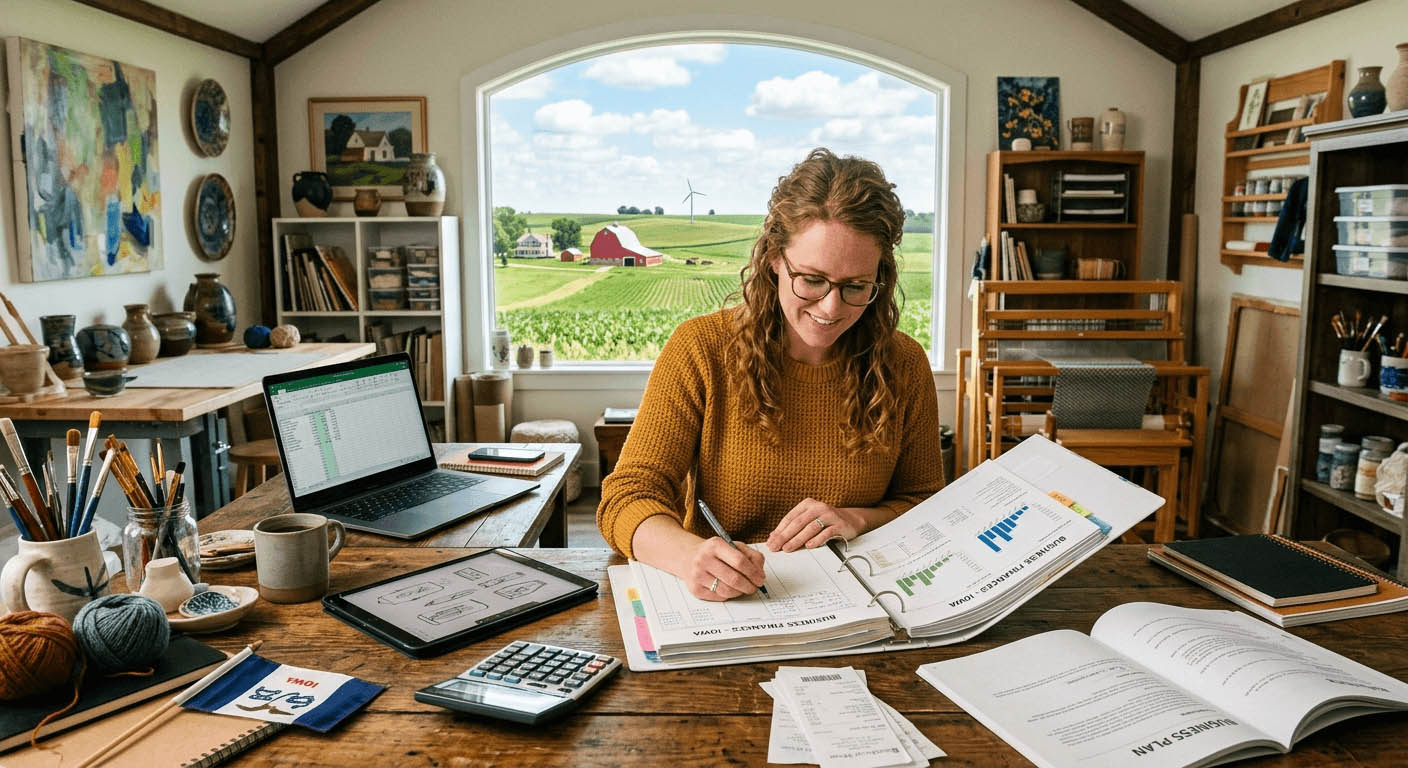
Making a living from creative work in Iowa is genuinely possible. Cedar Rapids, Iowa City, and the communities threaded through the Creative Corridor have become real hubs for working artists, independent designers, and craft-focused makers. The energy is real. The markets exist. What trips most people up is not the absence of talent or even the absence of customers. It is the absence of a financial foundation strong enough to hold everything together when things get unpredictable.
Most creative professionals spend years refining their craft and very little time understanding how money actually moves through a one-person business. That gap tends to surface at the worst possible moments: a slow January, a client who takes 90 days to pay, or an unexpected equipment cost that wipes out a month of margin.
Getting your finances in order does not mean becoming an accountant. It means building basic systems that let you keep creating without constantly wondering whether the numbers are going to hold.
For Creative Entrepreneurs in Iowa’s Corridor
- Set income targets before committing to studio space or new overhead costs
- Price your services from real numbers, not gut instinct or competitor guesswork
- Use platforms designed for solo operators, not corporate finance teams
- Know your break-even point before you name a project price
- Separate personal and business spending from the very first payment you receive
Why Money Talk Feels Foreign in Creative Communities
Artists and designers in Iowa often describe themselves as “not really a business person.” That self-image is understandable. Creative training rarely touches on cash flow, tax obligations, or pricing strategy. But the moment you accept payment for your work, you are operating a business, whether you frame it that way or not.
The real cost of avoiding financial conversations shows up quietly over time. You undercharge because you are not sure what your work is actually worth in measurable terms. You overspend on materials because you are not tracking where money goes month to month. You miss quarterly tax deadlines because nobody told you that freelancers pay taxes differently than employees.
None of this reflects a failure of creativity or ambition. It reflects a knowledge gap that most art programs, design schools, and maker communities simply do not address. The good news is that knowledge gaps are fixable.
The Most Common Financial Blind Spots for Solo Creatives
These patterns come up again and again among independent creatives who are talented, busy, and quietly stressed about money:
- Not tracking income month to month, so slow periods catch them completely off guard
- Pricing based on what others seem to charge rather than what covers their own specific costs
- Running personal and business purchases through the same account
- Skipping quarterly estimated tax payments and facing a large bill each April
- Underestimating how long clients take to pay, creating short-term cash crunches
- Taking on studio or equipment costs before their income baseline can comfortably support them
- Treating financial admin as something to deal with “later,” which becomes never
Each of these is fixable. The fix starts with deciding that financial management is part of your creative practice, not something separate from it.
Setting Income Goals Before You Commit to Studio Costs
One of the most expensive decisions a solo creative can make is signing a lease or committing to shared studio space before they understand their current income baseline. A studio in the Corridor might feel affordable at $400 or $600 a month. That cost is only manageable if existing revenue can absorb it without stress.
Before committing to any fixed overhead, work through your income targets with genuine clarity. A disciplined approach to business planning can show you whether you are actually ready for a new cost or whether you are running on optimism about numbers that have not yet appeared in your account consistently.
The process is not complicated. Total your average monthly income over the past six months. Subtract all current monthly expenses. What remains needs to cover the new overhead, your quarterly taxes, a savings buffer, and the slow months that hit every solo creative at some point during the year.
If the math does not work yet, that is useful information. It tells you exactly what revenue gap needs closing before you commit.
Pricing Creative Services with Actual Numbers
Creatives in Iowa tend to underprice their work for two reasons. They feel uncomfortable discussing money with clients they genuinely like. And they price from instinct rather than financial data.
The fix for the second problem is straightforward. Before you set a rate for a project or a retainer, run your numbers through a break-even calculator. This tells you the minimum you need to earn to cover your costs before a single dollar of profit enters the picture. That number becomes your floor, not your ceiling. Once you know your floor, you can price above it with real confidence.
For hourly rates, factor in all the time clients are not directly paying for: emails, proposals, revisions, admin work, and marketing. If you bill for 20 hours a week but put in 35 hours of actual work, your real hourly rate is far lower than the number on your invoices. Closing that gap starts with knowing it exists.
What to Include When Calculating Your Rate
- Monthly overhead: rent, software subscriptions, materials, and insurance
- Self-employment tax obligations, typically around 15 percent of net income
- Non-billable hours per week spent running the business side of your practice
- A savings buffer for equipment replacement and unexpected slow periods
- Your actual desired take-home pay after all costs and taxes are accounted for
Platforms Built for One-Person Creative Operations
Most accounting software was designed for businesses with finance teams. The interfaces assume someone’s full-time job is handling the numbers. That is not the reality for a ceramic artist selling through two galleries and a weekend market, or a graphic designer managing five ongoing client retainers from a home studio.
A growing category of solopreneur tools has emerged specifically for one-person operations. These platforms handle income tracking, expense categorization, invoice creation, and basic reporting without burying you in enterprise-level features you will never use. They are designed around the truth that you have a few hours a month to keep your books current, not a full-time staff member dedicated to the task.
When evaluating a platform, look for these features specifically:
- Clean invoice creation with payment links built in
- Automatic expense categorization connected to your bank
- Simple income and expense reports you can generate before tax season
- Mobile access for logging receipts and expenses at markets, fairs, and shows
- Pricing scaled for one-person operations, not growing teams with complex needs
The goal is to spend less mental energy on financial admin so you have more of that energy for your actual work. The right tool should feel like it operates quietly in the background while you stay focused on what you make.
Separating Your Money and Staying Ready for Tax Season
One of the highest-impact habits a solo creative can build costs nothing and takes about 20 minutes to set up: a dedicated business bank account. Separating personal and business spending makes income and expense tracking dramatically cleaner. It also protects you if you are ever audited, because your financial records are clear rather than buried in a mix of personal transactions and business purchases.
Beyond the bank account, creatives working independently in Iowa are responsible for paying quarterly estimated taxes. The IRS expects self-employed individuals to pay taxes four times a year, not in a single lump sum each April. Missing these payments results in penalties that chip away at margins that are already thin for most solo operators.
A practical habit: set aside 25 to 30 percent of each payment as you receive it. Treat that portion as untouchable from the start. It does not belong to your take-home income. Building this into your process from the first payment removes the year-end panic that catches independent creatives off guard more often than it should.
When Your Numbers Start Catching Up to Your Talent
Getting finances in order is not a one-time event. It is a set of habits that compound over time. Artists and makers who build even basic financial systems into their routine consistently report less stress, clearer pricing decisions, and more room to take on projects they actually want rather than scrambling to say yes to anything that pays.
The Creative Corridor is full of people with genuine skill and real market demand for what they make. The ones who build lasting creative businesses tend to be the ones who take financial management as seriously as they take their craft. Not because money is the whole point, but because financial stability is what gives creative work room to grow and breathe.
Start with your income targets. Know your floor before you name a price. Use platforms built for the way you actually work. Separate your money from day one. Pay your taxes on schedule. Review your numbers once a month.
That is not a complicated system. It is a consistent one. And in finances, as in any creative practice, consistency is what makes the real difference over time.